Blotato alternatives: 5 options and what each really costs
Blotato alternatives compared on live pricing, platform reach and whether they make the video at all. Verified numbers for faceless creators in 2026.
October 9, 2026 · 14 min read

Author
codeBeboo
Google has 110 indexed results for the word "blotato", and roughly 22,000 Americans searched it in each of the last two months. The one page on the front page that promises alternatives is a single vendor's advertorial, and the traffic estimate on it is under half a visit a month. Nobody has written this down.
So here it is, with every price read off a live pricing page on 9 October 2026. The useful question is not which tool is better. It is which of the two jobs Blotato bundles you actually need, because the answer changes what you should pay by a factor of ten.
Blotato alternatives at a glance
Blotato is a distribution layer with generation bolted on. It publishes to nine networks from one API, writes the copy, and spends credits on images and video. It does not interview you about your channel. That matters, because most people hunting a Blotato alternative are not unhappy with the posting. They are unhappy that they still have to make something to post.
| Tool | Entry price | Accounts included | Makes the finished video | Free route |
|---|---|---|---|---|
| Blotato | $29/mo | 20 | Credits for images and clips | 7 day trial, card required |
| Taletok | $27/mo | 1 YouTube channel | Yes, script to finished upload | 2 free videos, no card |
| Postiz | $29/mo cloud | 5 on entry plan | 3 AI videos a month | Self host under AGPL 3.0 |
| Buffer | $5 per channel | 1 per $5 | No | Free forever, 3 channels |
| n8n or Make direct | Your own API keys | Unlimited | No | Yes, you build it |
The company's own figures, taken from its site: 10,000 operators, 667,000 posts published last month, nine platforms, 1,800 API requests an hour. It claims 4.8 out of 5 on Trustpilot across 387 reviews. Respectable numbers for a bootstrapped product, and I have no reason to doubt them.
What a Blotato credit actually buys
This is where the category gets slippery, and credit to them, they publish more than most. The pricing FAQ says credits "power AI generation: images, videos, and voice" and that "each credit roughly maps to a generated image or a few seconds of generated video."
Read that second clause carefully. "A few seconds" is doing an enormous amount of work.
At two seconds a credit, one 60 second short costs 30 credits, so Starter's 1,250 credits a month buy you 42 shorts. At five seconds a credit, the same short costs 12 credits and the same plan buys 104. That is a 2.5 times spread inside one published sentence, and it is the difference between $0.70 and $0.28 a video on identical money.
A second figure pins it down, and it was published by accident. The annual promo throws in 5,000 credits described as a "$30 value". That prices a credit at $0.006. Run Starter through it: 1,250 credits is $7.50 of generation inside a $29 bill, so 74% of Blotato pricing on the entry plan is the posting layer, not the video. On Creator at $97 for 5,000 credits the generation is worth $30, and the plan is still 69% distribution.
That is not a criticism, it is the honest shape of the product. It also tells you exactly when this is the wrong purchase: when you need the 74% less than you need the 26%.
Taletok makes the video Blotato assumes you have
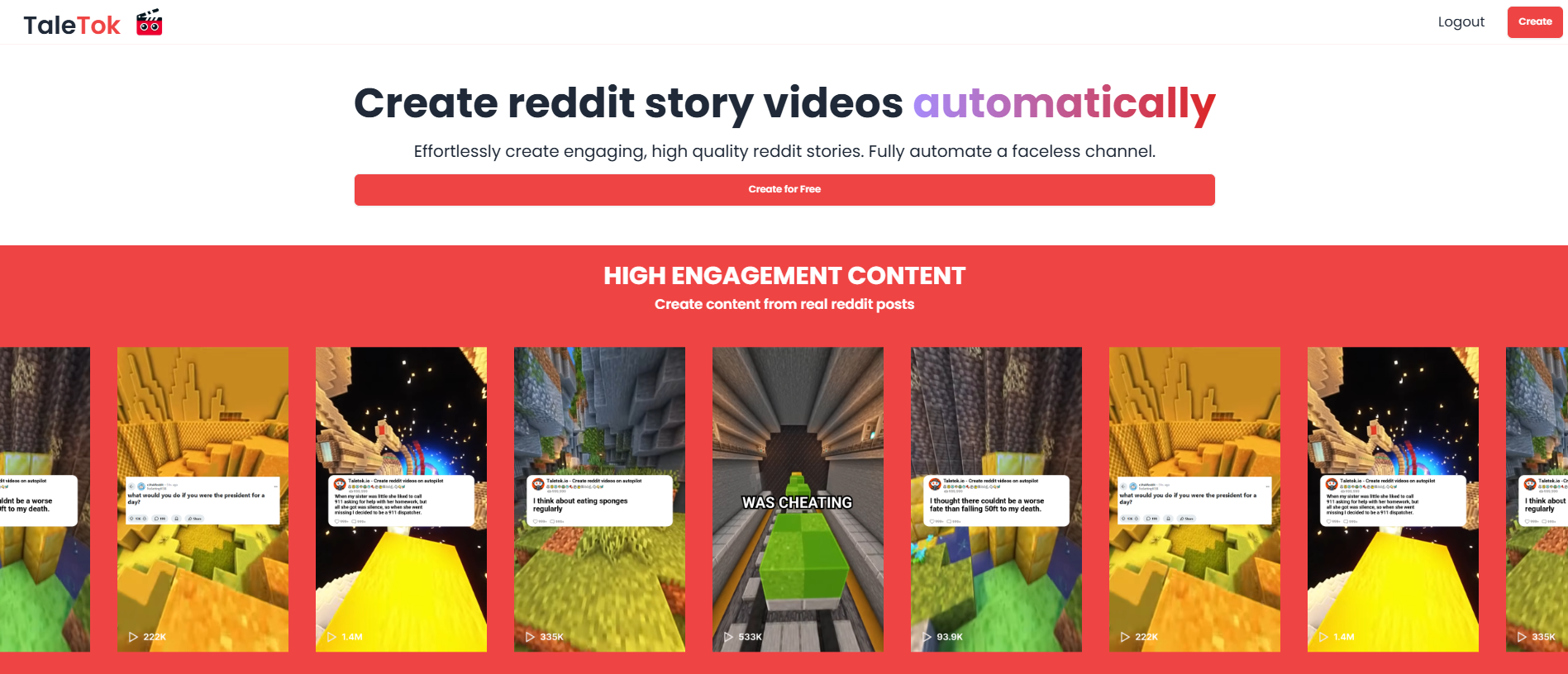
Taletok starts one step earlier. You give it a topic or a Reddit thread, it writes the script, generates the scenes, narrates with an ElevenLabs voice, burns the captions, and hands back a finished upload. Then it schedules it to YouTube on its own. If you are still working out what YouTube automation actually involves, that is the whole loop in one tool.
Starter is $27 a month for 100 minutes of finished content, which is $0.27 for a 60 second short. Pro is $47 for 500 minutes, which drops the same short to $0.094. Channel Year billing takes Starter to $162 for the year, an effective $13.50 a month, and credits roll over for up to two months. New accounts get 2 free videos with no card.
Now the limitation, stated plainly, because a comparison that hides one is useless. Taletok autoposts to YouTube only. You can download any reel and upload it anywhere, and plenty of people do exactly that for faceless TikTok videos and for a faceless Instagram account, but the scheduler is one platform deep where Blotato's is nine. If posting to nine networks on a timer is the thing you are paying to solve, buy the nine and stop reading.
My opinion, and it is the reason this post exists: the posting is the cheap part. A creator in r/n8n made the point better than I can while arguing the opposite side. Paying for a posting layer "definitely makes sense (except for youtube uploading)", because they "struggled with that stupid ass meta graph api for weeks and tiktok doesn't even have a public api." YouTube is the one network where the API is not the hard part. If YouTube is your channel, you are buying a nine platform solution to a one platform problem.
The audience asks this out loud and nobody answers it. Under the founder's own beginner tutorial, a commenter writes: "I'm just getting started, but hate showing my face, and so keep procrastinating. Is Blotato a way to get going and establish a posting workflow." The honest answer is that a posting workflow is not what is stopping them. A finished video is.
Postiz: the same job on hardware you own
Postiz is the closest like for like swap, and it is the one most people in the n8n threads land on. Cloud Standard is $29 a month, matching Starter, and every plan includes the MCP server, the CLI and the API. It lists over 30 destinations, including the awkward ones the nine platform list skips: Reddit, Discord, Telegram, Mastodon, Whop, Skool, WordPress.
The catch is in the fine print of that same $29. Standard gives you 5 channels against Blotato's 20, and 3 AI videos a month. Three. That works out at $9.67 per generated video if generation is why you are there. Team at $39 raises it to 10 videos and 10 channels.
The real Postiz argument is the licence. It is AGPL 3.0 on GitHub with over 3,300 commits, so you can run it yourself and the software costs nothing. You pay in server time and in debugging. The r/n8n consensus is blunt about the trade: the hosted option is "the safer hosted bet if you want less babysitting, Postiz if you're okay owning the weird edge cases."
One correction worth making, because it is the most upvoted wrong answer in these threads. "Postiz, for example, is a great free alternative" gets repeated a lot. Postiz cloud is $29 a month, identical money. Only the self hosted build is free, and self hosted means you are now the person who gets paged when an Instagram token expires at 3am.
Under six channels, Buffer costs less
Buffer is unfashionable and it is still the right answer for a lot of people. Free forever covers 3 channels with 10 scheduled posts each and API access on 3,000 requests a month. Paid is $5 per channel per month on Essentials, or $60 a year per channel.
Do the division and the crossover is sharp. A flat $29 equals Buffer at 5.8 channels. Under six connected accounts you are paying for capacity you are not touching, at $1.45 per account against Buffer's $5 but spread over twenty accounts you will never open. Over six channels the flat fee wins outright: twenty channels on Buffer Essentials is $100 a month against $29.
Buffer generates no video and does not pretend to. That is a feature if you already have the file.
The YouTube only route needs no posting layer
If your output is one faceless YouTube channel, the honest answer is that you need neither tool. The YouTube Data API uploads and schedules, n8n and Make both have nodes for it, and the quota is generous for one channel. Taletok folds that step in, so the only thing left to buy is production.
The reason the n8n crowd pays for a posting layer anyway is TikTok and Instagram. Meta's Graph API is genuinely miserable and TikTok's content posting API is gated. As one of the mapped comparisons in r/n8n noted, "video upload limits and account auth are where these break after a few weeks", which is a real argument for renting someone else's problem. It is not an argument for renting it when your only destination is YouTube.
Where the refund promise actually lives
This is the section nobody in this category writes, and it takes four minutes to check.
The Blotato pricing FAQ says: "If something genuinely doesn't work, email [email protected] within 14 days and we'll make it right." Friendly, and conditional on a fault, not on you disliking the output.
The Terms of Service, last updated 18 May 2026, say something narrower. Clause 4.1: all fees "are non-refundable, except as provided in these Terms or as required by law." There is no refund clause anywhere else in those Terms, and the /refund-policy path on their domain returns a 404. So the 14 day promise lives on a marketing page, not in the binding agreement you accept at checkout.
Three more lines from the same document, worth knowing before you connect nine accounts. Clause 1.2 reserves the right to discontinue any feature "with or without notice" and disclaims liability for "any loss of access to your data", with you "solely responsible for retaining copies" of your content. Clause 4.5 says a delinquent account can be charged collection and chargeback fees on top of what you owe. And the whole thing opens with a binding arbitration notice and a class action waiver.
Compare the others. Buffer has a genuine free tier, so you can test without a card at all. Postiz self hosted has no bill to refund. Taletok gives 2 free videos up front for the same reason: the trial is the refund policy. That FAQ agrees, in writing, that "the free trial is the better way to make sure it fits before you commit."
Picking one without a spreadsheet
The decision collapses to one question. Does the video exist yet?
- It exists, and you post to one or two places. Buffer free, or Buffer Essentials at $5 a channel.
- It exists, and you post to eight or more places. Stay on the $29 flat fee. It is genuinely good value past the crossover and the n8n nodes are first party.
- It exists, you post everywhere, and you want to own the stack. Postiz, self hosted.
- It does not exist, and the channel is YouTube. Production is the bottleneck, so spend there. YouTube automation with Taletok at $27 covers script, scenes, voice and the upload.
- It does not exist and you post everywhere. Pay twice, honestly. Something makes the video, a distribution layer ships it.
One last thing to watch while you research, because it shapes everything you will read. The vendor's own pricing page lists six YouTube reviews under the heading "What independent creators say", described as "published on the creators' own channels rather than recorded for us". One of those reviewers also appears on the same page as a filmed paying customer testimonial, and again as a named case study. Its reviews page says "No incentives, no scripts." There is an affiliate programme linked in the footer, and that same reviewer's written review carries a referral tag on every one of its eight links back to the product.
None of that makes the review wrong, and to their credit the reviews page links out to Trustpilot, Capterra, SourceForge and G2 so you can read the one star reviews yourself. It does explain why blotato discount code is a search term with real volume, and it means the word "independent" is doing less work than it looks like. Check any Blotato review for a referral tag in its outbound links before you weigh the verdict. The same test applies here: Taletok is our product, and we have told you where it loses.
For the production side, our Crayo AI alternatives breakdown covers the generators proper, and starting a faceless YouTube channel covers the channel itself.
FAQ
What is Blotato AI?
Blotato AI is a social media automation platform that publishes to nine networks from one unified API, with an MCP server so agents like Claude or ChatGPT can post for you. It writes copy, generates images and short video from credits, and runs DMs and comment replies. Blotato Inc. is the company named in its Terms of Service, and the official n8n and Make nodes are why it shows up constantly in automation communities.
How much is Blotato per month?
Three plans, read live on 9 October 2026. Starter is $29 a month for 1,250 AI credits, 20 social accounts and up to 900 TikTok posts. Creator is $97 for 5,000 credits and 40 accounts. Agency is $499 for 28,000 credits. Annual billing saves about 17%, so Starter works out near $24 a month. There is no permanent free plan. One thing the plan list does not spell out: "mobile friendly" means the web app resizes, not that there is an app. There is no Blotato app on the App Store or Google Play, so schedule from a browser.
What are some free alternatives to Blotato AI?
Two are genuinely free rather than trial free. Buffer's Free plan covers 3 channels with 10 scheduled posts each and 3,000 API requests a month, forever. Postiz is AGPL 3.0, so self hosting costs nothing beyond the server you run it on. For the video side, Taletok gives 2 free videos without a card. Everything else in this category is a timed trial.
Who is the owner of Blotato?
Sabrina Ramonov, per the company's own about page. She graduated from UC Berkeley in computer science and physics, founded the AI customer experience startup Qurious.io and sold it to Pegasystems at 30, and was named to Forbes 30 Under 30 in enterprise tech in 2018. The site credits her with 3M followers and 33M monthly organic views across platforms, and says the product was built on $0 of funding. Her own YouTube channel hosts the largest Blotato tutorials, including a 48,000 view walkthrough, which is worth knowing when you are weighing a review: the biggest videos about this tool are made by the person selling it.
Is Blotato free, and what does the trial include?
Not free, but there is a 7 day trial on every plan that includes all features except the API, plus "a limited amount of AI credits". Your card goes on at signup and you are charged when the trial ends unless you cancel first, which you can do in account settings or by emailing support. The company says it emails you before the trial expires.
Will all my faceless videos end up looking the same?
This is the real complaint about every tool here, Taletok included. It comes from running one template at volume, not from the software. Rotate the format rather than the topic, vary the visual style every few uploads, and change your caption treatment weekly. A commenter in r/aitubers framed the odds well: the earnings screenshots are "survivorship bias" and "for every one that works there are 500 that get 12 views per video forever." The ones that work vary the output.
Continue reading
In this guide series
Ready to put this into practice?
Start a faceless channel that posts itselfRead more
Whop Clipping: What Clippers Actually Get Paid in 2026
Whop clipping pays per 1,000 verified views. The per clip cap, the seven day window and the licence you agree to decide how much ever reaches you.
Viblo AI Alternatives: Real Prices and Refund Terms 2026
Viblo AI costs $25 a month for 30 shorts. We costed four faceless video tools per finished short and read the refund policy each one makes you accept.
How much does YouTube pay per view? The real 2026 numbers
How much does YouTube pay per view? There is no per view rate. Here is the RPM and CPM arithmetic, and what a faceless channel actually keeps in 2026.
TikTok Creator Rewards Program: What It Really Pays in 2026
The TikTok Creator Rewards Program pays on qualified views, not the views in your analytics. Here is the real RPM range, the nine video rules, and the maths.