What Is a Faceless YouTube Channel? Formats and 2026 Rules
A faceless YouTube channel never shows the creator on camera. Here are the 6 formats, what each costs, and the monetisation rule that catches most of them.
November 4, 2026 · 8 min read

Author
codeBeboo
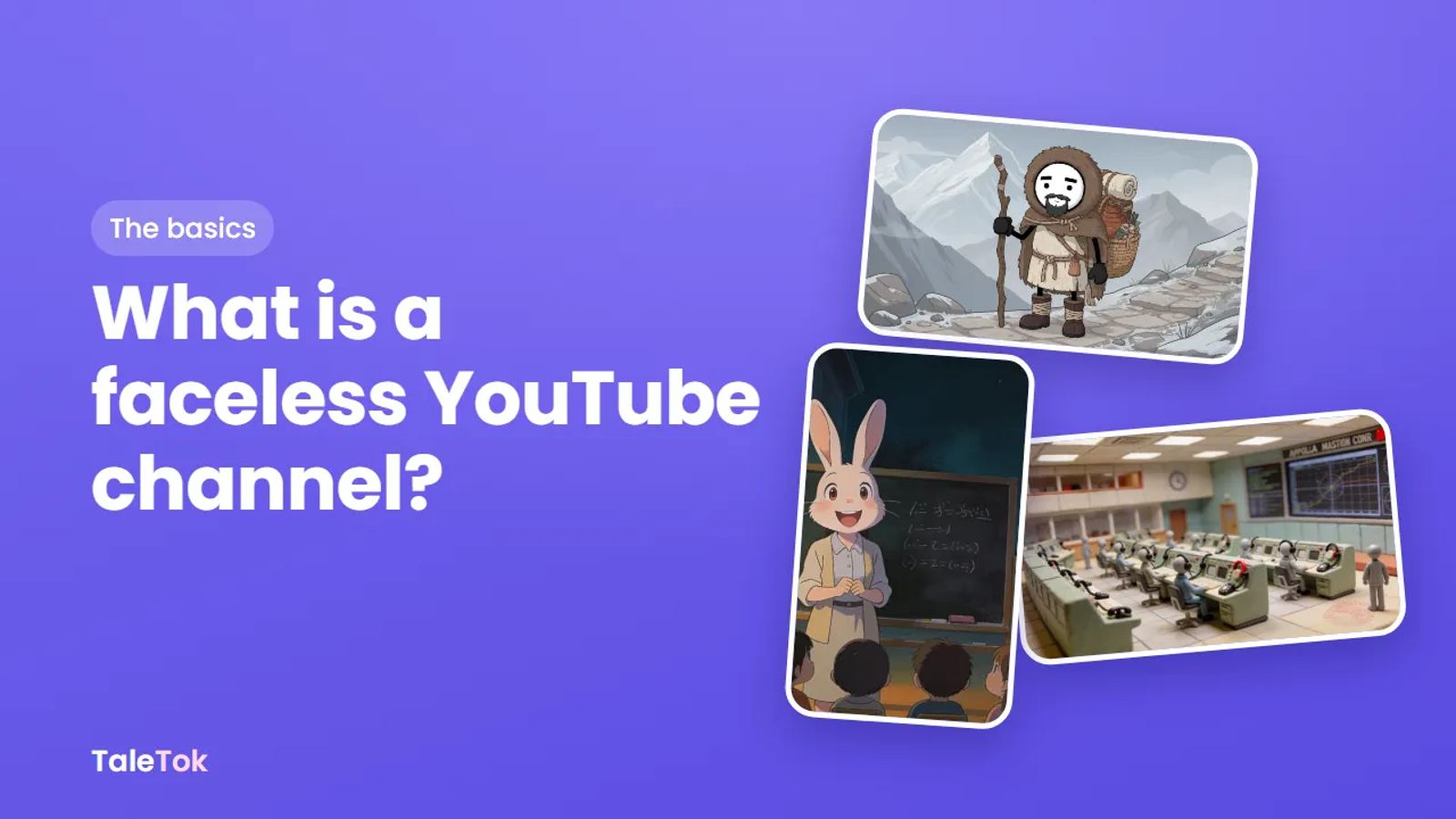
A faceless YouTube channel is a channel where the creator never appears on camera. The videos run on voiceover, animation, stock footage, screen recordings or text instead. It is a format, not a loophole: the same monetisation rules apply as for any other channel.
This guide defines the term, sorts the six formats you will actually see, and covers the one 2026 policy that decides whether a faceless channel earns. If you already know you want one, the step-by-step guide to starting a faceless YouTube channel is the next read.
What counts as faceless, and what does not
Faceless means no face on screen. It does not mean no person behind the channel.
A channel with a hidden creator who writes every script, picks every angle and records every voiceover is faceless. A channel where software picks a Reddit post, reads it aloud and uploads it with no human decision in between is also faceless, but it is a different product and YouTube treats it differently. Most beginner guides blur the two. The rest of this post keeps them apart.
Three things are often mistaken for faceless and are not:
- Voice-only podcasts on a still image. No face, but also no video work. YouTube sees a low-effort upload.
- Anonymous channels that show hands or a body. Partly faceless. Fine, just a different label.
- Re-uploaded clips with a caption. Faceless on a technicality, and the fastest route to a reused content rejection.
The 6 faceless YouTube channel formats
Here is the whole field in one table. Production time is for a 60-second video once your setup is built; cost is the usual monthly tool spend.
| Format | What is on screen | Typical effort per video | Main risk |
|---|---|---|---|
| Reddit story | Gameplay or stock background, captions, TTS voice | 20 to 40 minutes | Reused content if you read posts verbatim |
| Stickman or 2D animation | Animated characters | 1 to 3 hours by hand, minutes with a stickman animation maker | Sameness across a catalogue |
| AI 3D story (Zack D Films style) | Generated 3D scenes | 30 to 90 minutes | Template look |
| Documentary or explainer | Stock and archive footage, motion graphics | 3 to 8 hours | Highest effort, highest RPM |
| Screen recording or tutorial | Your screen | 1 to 2 hours | Needs real expertise |
| Compilation or top-10 list | Clips and images | 1 to 3 hours | Weakest originality case |
My opinion: skip compilations. They look like the easiest option and they are the format most likely to meet a monetisation rejection at the end.
For concrete examples of each, faceless YouTube channel ideas lists 27 niches with RPM estimates, and the best faceless YouTube channels shows what the winners look like.
Can you make money with a faceless YouTube channel?
Yes, but only after clearing the same bar as everyone else. YouTube pays ad revenue at 1,000 subscribers plus either 4,000 qualified public watch hours in 12 months or 10 million qualified Shorts views in 90 days (YouTube Help, checked 4 November 2026). From 1 February 2027 the long-form figure doubles to 8,000 hours and the Shorts figure to 20 million views for new applicants, as covered in our YouTube monetization requirements breakdown.
Faceless does not change those numbers. What it changes is how you get reviewed.
The rule that catches most faceless channels
YouTube renamed its "repetitious content" policy to inauthentic content on 15 July 2025. The channel monetisation policies now ask for content that is not "mass-produced, generic, repetitive, or manipulative", and they name AI-generated content made with generic or unoriginal templates as an example (YouTube channel monetization policies, checked 4 November 2026).
Faceless channels hit this harder than face-on-camera channels for a simple reason. A reviewer can see a human in a vlog. In a faceless video the only proof of a human is the script, the angle and the edit choices.
Our own data shows how this plays out. In an anonymised set of 917 videos across 49 new AI channels, the 710 templated Reddit-story uploads that auto-posted on a schedule had a median of 0 views, and 95.4% finished under 10 views. The 76 creator-edited videos had a median of 10.5 views, and 22.4% passed 1,000. Small samples, early-stage channels, but the direction is not subtle. The full breakdown is on the AI slop on YouTube statistics page.
The practical test: if you removed the voice and visuals, would your script still be recognisably yours? If yes, you are running a faceless channel. If no, you are running a template.
Faceless or on camera: which is better?
Faceless wins on three things. It scales, because one person can run several channels. It is replaceable, because the voice and visuals can change without losing an audience that came for a face. And it protects privacy.
On camera wins on trust and sponsorships. Brands pay people, and a face is the shortest route to a personal brand. If your plan is a coaching business or high-ticket sponsors, a face helps. If your plan is ad revenue from stories, explainers or documentaries, it does not.
A hybrid works for many creators: keep the face off screen and keep a consistent, recognisable voice. That is how most successful faceless channels get an audience that remembers them.
How a faceless channel gets made in practice
The workflow is the same across formats: pick a niche, write the script, generate or source visuals, add a voice, edit, post. Where the formats differ is which step you automate.
You can do the whole chain yourself, or hand the repetitive parts to a tool. A faceless reels generator covers Shorts-style videos; for a deeper look at what automation does and does not replace, read what is YouTube automation. Before you post at volume, run the account warmup routine so a new channel is not judged on its first three zero-view uploads.
FAQ
Can you be a faceless YouTuber?
Yes. Many monetised channels never show the creator. The channel earns under the same Partner Program rules: 1,000 subscribers plus 4,000 watch hours or 10 million Shorts views today, and higher bars for new applicants from 1 February 2027.
Is a faceless YouTube channel allowed to monetise?
Yes, provided the content is original and not mass-produced. YouTube's inauthentic content policy, in force since 15 July 2025, is the rule to read before you apply.
How much does a faceless channel make?
There is no fixed figure. Revenue depends on watch time and niche, and many new channels earn nothing for months. In our data on 49 new AI channels, none reached 100,000 lifetime views.
What is the easiest faceless format to start?
Reddit stories have the lowest production time, at 20 to 40 minutes a video, but also the highest rejection risk if you do not rewrite the story. Screen-recording tutorials are slower but safer.
Is faceless the same as YouTube automation?
No. Faceless describes what is on screen. Automation describes how much of the production is handed to software. A faceless channel can be fully manual.
Continue reading
In this guide series
Ready to put this into practice?
Generate your first faceless videoRead more
StreamLadder Alternatives: 4 Tools Priced for 2026
StreamLadder alternatives split by one question. Do you have a stream to clip? We priced Opus Clip, Eklipse and Taletok against StreamLadder's live plans.
YouTube automation tools in 2026, priced and compared
The YouTube automation tools worth paying for in 2026, with real October prices, what each one actually automates, and what a 3 video a week channel costs.

How to Make a Stickman Animation (by Hand vs with AI)
How to make a stickman animation in 2026: frame by frame in Pivot Animator or FlipaClip, or with AI. Honest time and cost for each, and which suits your goal.

VEED Alternatives: The Monthly Price Is Actually $25
VEED's pricing card shows about $12 a month. That figure is the year divided by 12. Creator is $25 monthly, and a free export keeps the watermark.